AR Creator Tool
Designing and shipping a web-based authoring platform for Bose AR spatial audio experiences, from an SXSW MVP to branched narratives and a Disney collaboration. Named inventor on a granted U.S. patent.
In 2018, Bose released Frames — a pair of sunglasses that played audio without anything going into your ears. Embedded sensors tracked head orientation, which meant the hardware knew which direction you were looking at any given moment.
The question nobody had answered yet was: what do you actually build with that?
I was the lead designer on the Bose AR Creator Tools program from inception. It was a web-based authoring platform that let artists create spatial audio experiences and location-triggered stories, and a companion app called Bose Radar where Bose customers could experience what artists published. I joined fresh out of grad school and stayed with the program through multiple releases, two U.S. patent filings, and press coverage in The Verge and Engadget. One filing became a granted patent for augmented audio development.
The problem
Creating a single interactive audio experience for Bose AR required navigating a tangle of technical complexity such as encoding audio, decoding spatial positioning, managing GPS triggers and handling sensor input. The barrier to entry for artists was enormous. Our hypothesis was simple:
If we could abstract away that complexity, creators would experiment more freely, and experimentation would produce experiences nobody had imagined yet.
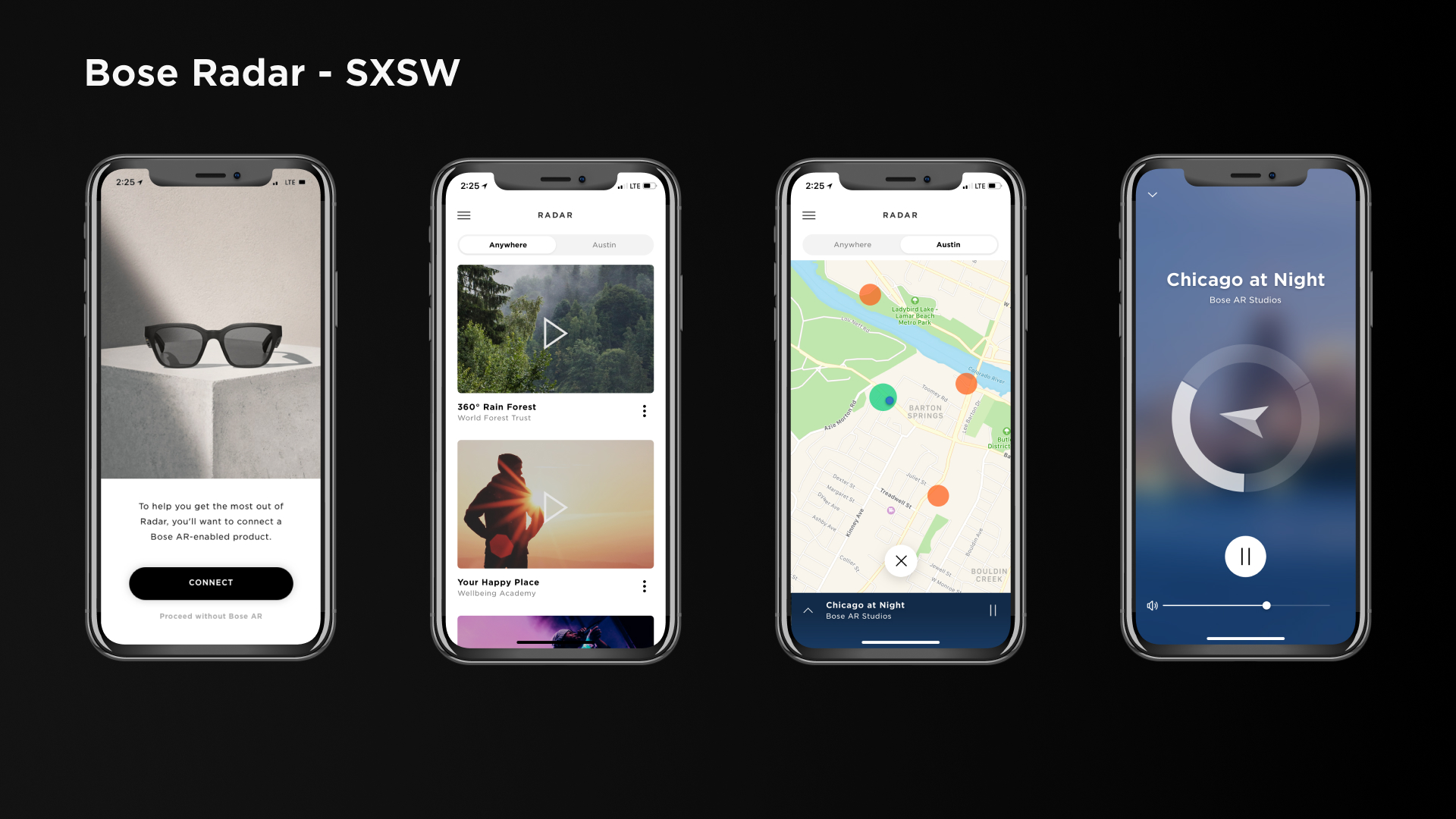
We identified three pieces that had to work together: a web-based authoring tool for creators, a TestFlight app to preview experiences before publishing, and Bose Radar, the production app where customers consumed the content.
V1 — shipped in 3 months for SXSW 2019
Our long-range vision was branched narrative (choose-your-own-adventure type stories) told through spatial audio. But we had three months to SXSW and a hard deadline. V1 had to be scoped to what we could actually ship and learn from.
During planning I sketched the authoring interface from scratch, trying to find the minimum surface that could express these interactions without overwhelming creators who had never worked in this medium before.
The first release let creators assign audio to head orientation wherein users heard different audio based on the direction the audio was assigned. The final V1 experience let a creator fill three segments of the orb with audio, add an outer ring as an intro, drop it on a map, hit Publish, and be done. We handled the encoding and transcription behind the scenes.
Artists could also place an “orb” on a GPS location: walk through that point wearing Bose Frames, hear a chime, opt into the experience. Simple. Concrete. Shippable.
V1 shipped, made rounds at SXSW and other creator festivals, and gave us our first real signal on what artists actually wanted to do next.
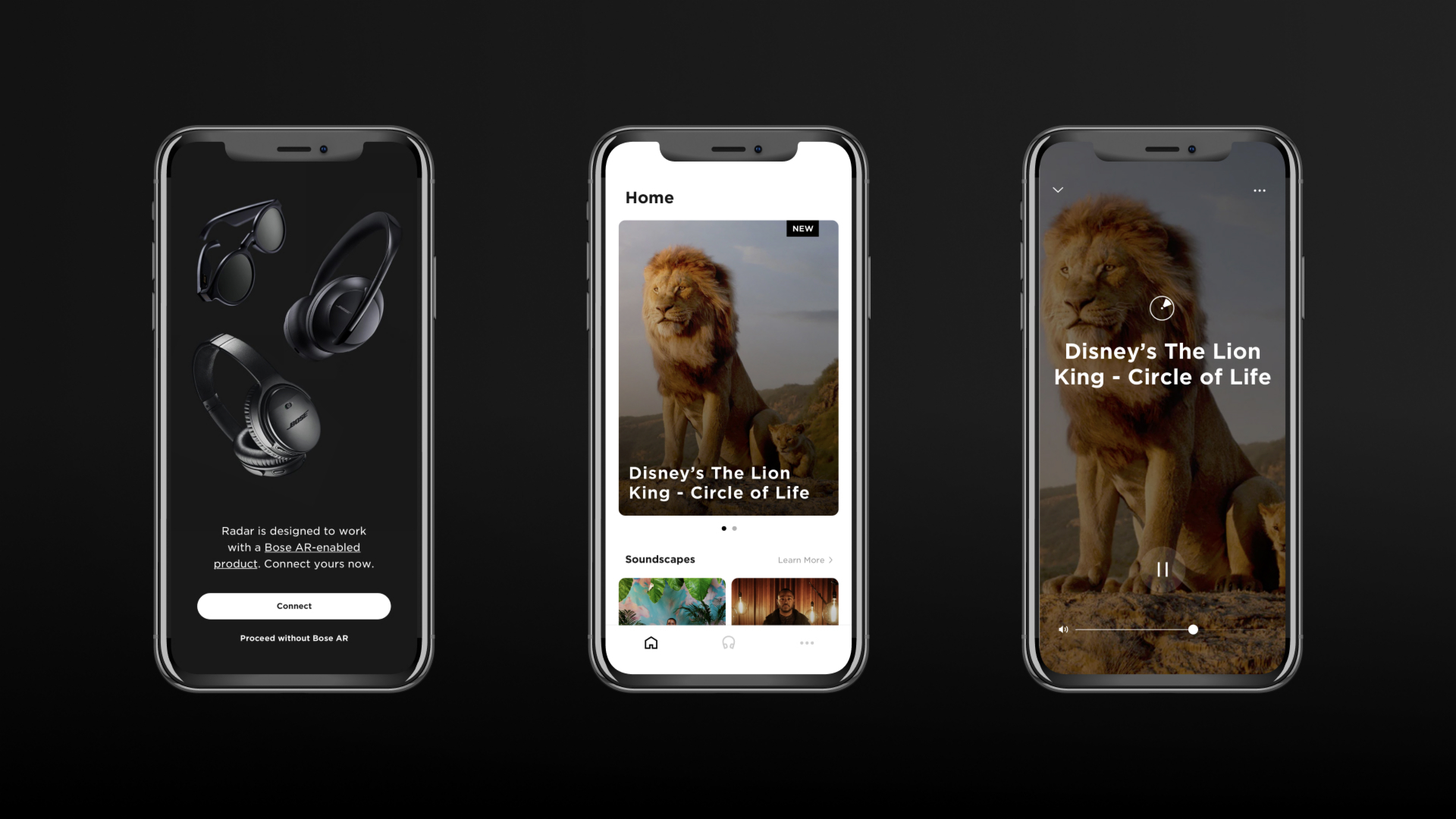
Bose also did a collaboration with Disney to release special Lion King tracks that were exclusively available on Bose Radar.
Branched narratives — and a technical decision that mattered
After V1, we ran 1:1 interviews with early creators. The ask was consistent: they wanted to tell branched stories. Not just orientation-triggered audio, but interactive narratives where a listener’s choices shaped what they heard next.
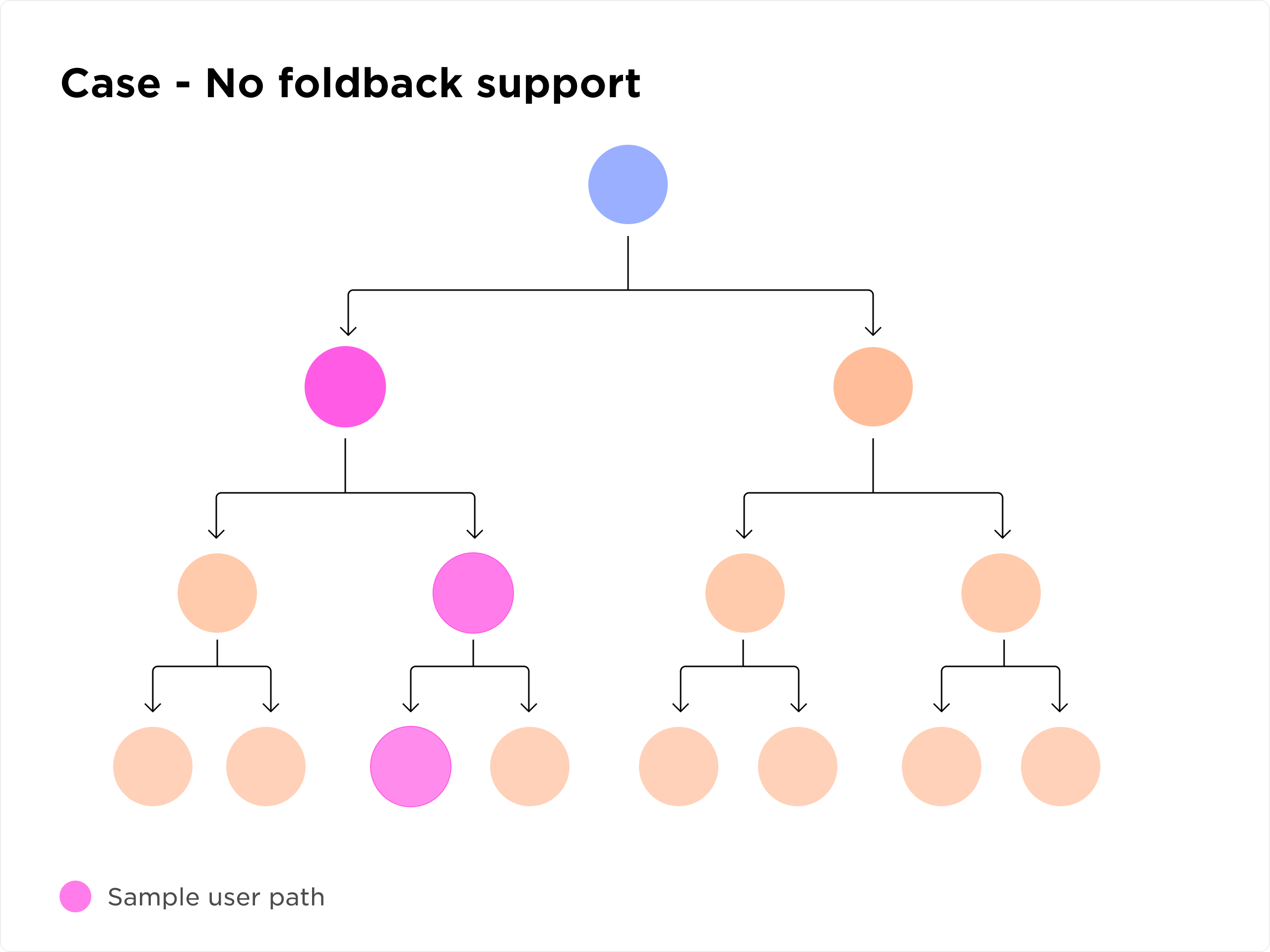
This was a significant lift. Before any design work could start, the team had to agree on how branched narratives would be architecturally represented. Engineering came back with a recommendation that we could support tree structures only wherein every branch point creates entirely new paths to the end.
I pushed back. A strict tree structure meant artists would have to create five times as much content to tell the same story, since shared endings would need to be duplicated across every branch. This would make it trickier and cumbersome for artists to experiment with. The right structure was a directed acyclic graph: multiple paths could converge on the same scene, letting creators reuse content across branches.
It was one of my first experiences learning when to pick a technical battle. This one was worth it.
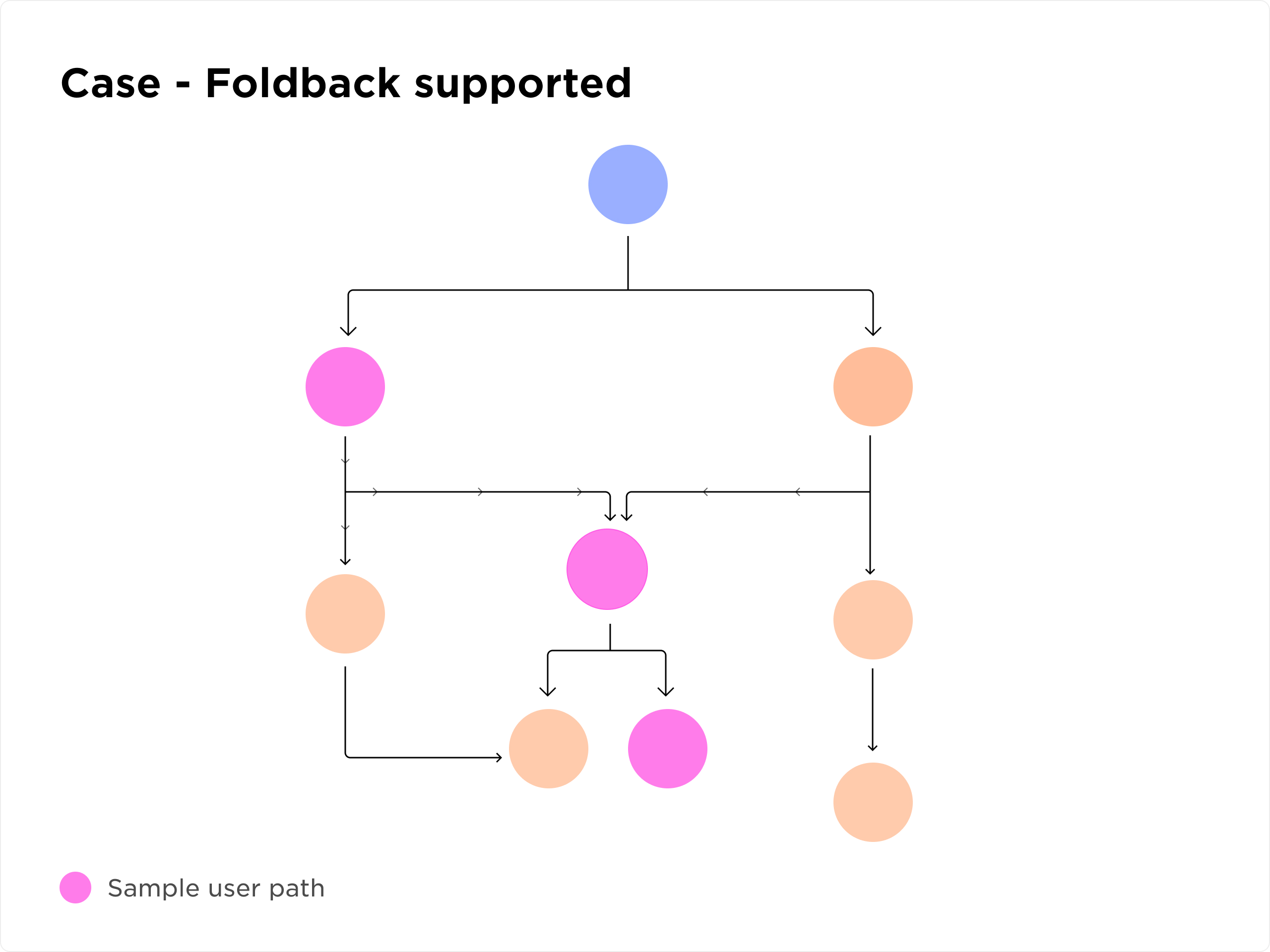
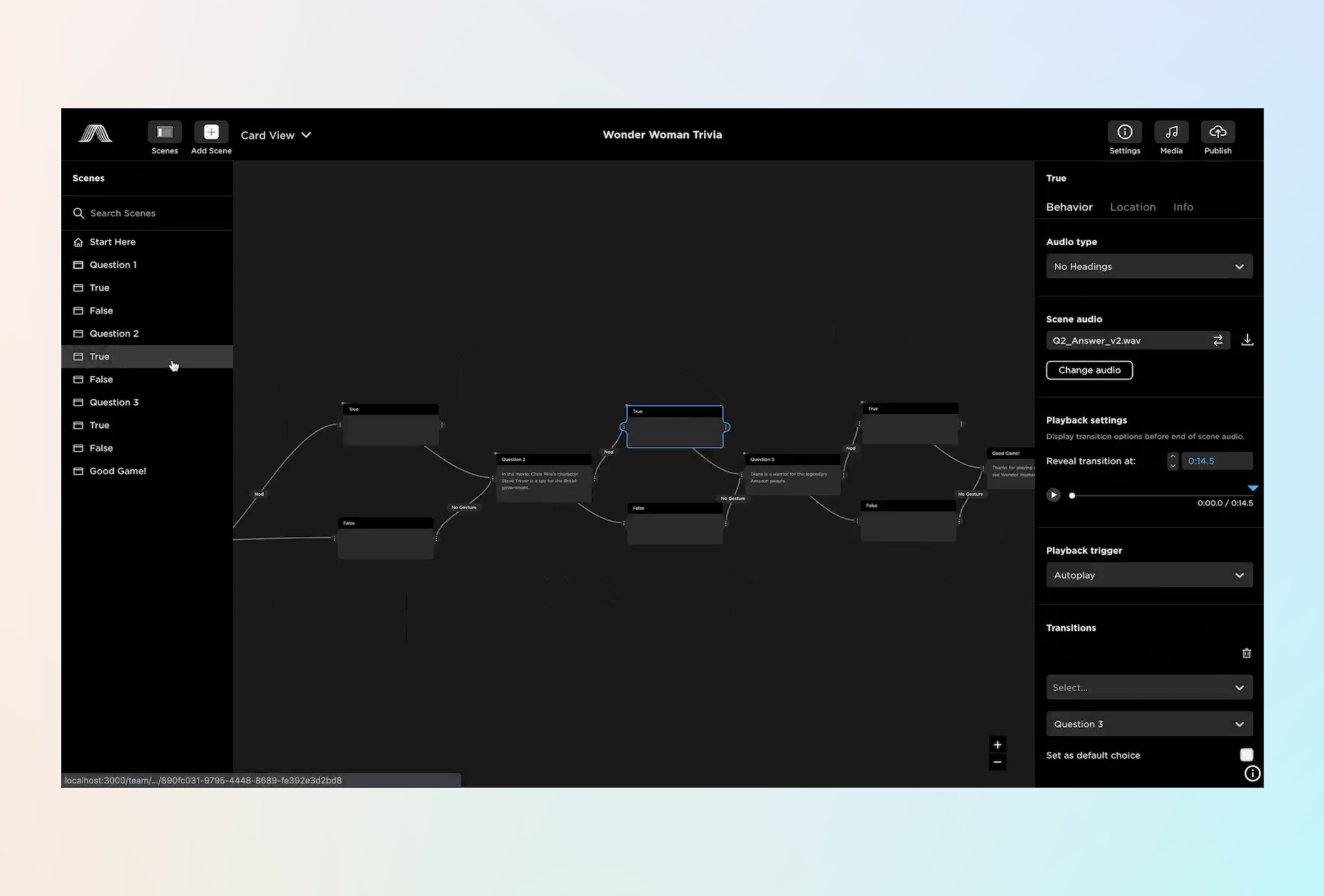
With the data structure settled, we built a node-based canvas editor where scenes were represented as cards and gesture triggers as connections between them. I worked directly alongside front-end engineers to define the interaction paradigms for the canvas: how you navigate it, how you connect nodes, how properties surface when you select a behavior.
Working that closely with engineers taught me more about design constraints in a few months than I’d learned in years of school. You find out fast which of your instincts are grounded in how things actually work, and which ones are just aesthetics.
We also improved the publishing workflow in this phase with clearer status feedback, 2x faster audio transcoding. I recommended a visual system refresh once the core interactions stabilized. Accumulated tech debt had made the interface harder to navigate than it needed to be, and user feedback confirmed that people weren’t sure where to find settings or controls.
Outcomes
The updated tool shipped to creators and the Radar app shipped to Bose customers. Disney released exclusive spatial audio experiences on Radar. Engadget and The Verge covered the platform.
4,000 DAU. 4,000 new users every week. 90% of new Bose AR users downloaded Radar for content.
What I took away
I came into this project fresh out of grad school, and it was genuinely the steepest learning curve of my career. A few things stuck:
-
Working directly with engineers is one of the fastest ways to grow as a designer. Not handing off specs but actually sitting with the people building it, understanding what’s easy and what’s hard, and finding the design solutions that live at that intersection.
-
I didn’t always pick my battles well. There were moments I pushed on things that didn’t matter and stayed quiet on things that did. The branched narrative architecture decision was one I got right. Others I let slide in the name of moving fast and later wished I hadn’t.
-
What I never compromised on was quality and pace. Shipping something I wasn’t proud of always cost more in the long run than the time it would have taken to do it right. Caring about the craft even under deadline is something I carried forward from this project into everything since.